

Over the past number of years, we’ve discussed the struggles of human-work-life in a variety of different dynamics with Human Resources leaders. There seems to be a common thread across teams, leadership, productivity and how it all points to company-wide performance, engagement and return on investment. That common thread is EQ. Studies have also shown that understanding why EQ matters is a central point of modern HR strategies, particularly when leaders seek to cultivate resilient organisational culture, and boost their employee engagement.
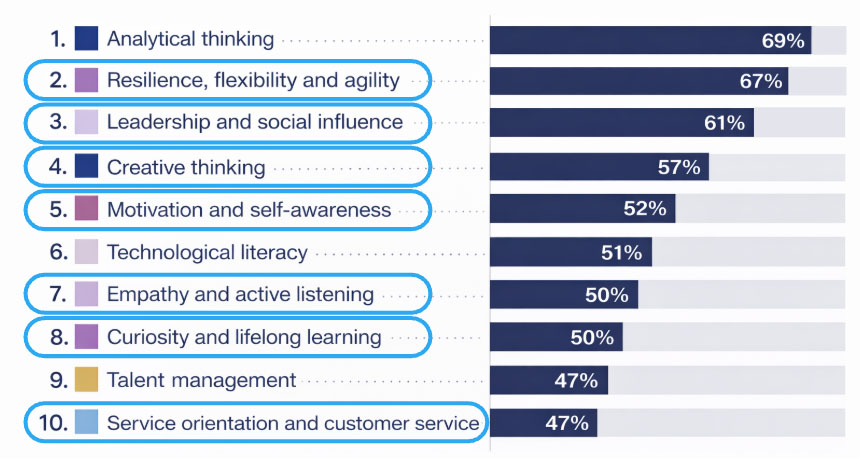
As companies look to navigate workplace complexities, augmented by artificial intelligence and other technological shifts, Emotional Intelligence has shifted towards being recognised as a strategic necessity rather than its previous conceptualisation in the domain of “soft skills.” According to the World Economic Forum Future of Jobs Report published in 2025, 7 out of the top ten ranked core skills employers stated to be critical in their workplaces are directly linked to Emotional Intelligence of the workforce:
- Resilience, flexibility and agility
- Leadership and social influence
- Creative thinking
- Motivation and self-awareness
- Empathy and active listening
- Curiosity and lifelong learning
- Service orientation and customer service
Top 10 skills stated to be core skills for their workforce, WEF Future of Jobs report 2025
The New Reality: AI, Technical Skills, and the Human Differentiator
It’s safe to say, organisations are witnessing a paradigm shift in the world of work: the automation of technical proficiency. For decades, traditional cognitive intelligence (IQ) was the primary metric for recruitment and career advancement. If you could perform complex calculations, code efficiently, or manage logistical data, you were considered a top performer. AI has changed the game, and quickly too, turning these technical skills into more of a commodity.
When an algorithm can solve a problem in milliseconds, the value of the human worker shifts entirely toward the traits that algorithms cannot replicate: empathy, adaptability, social judgment, and emotional nuance.
This shift welcomes a clear mandate for HR and business leaders, and the future of your workforce. It needs to become one that can leverage the emotional landscape to drive collaboration, more than one with performing tasks the quickest. Which brings us back to why EQ is so strategically important!
If your organisation can move with the times, in a sense, it lowers the risk of becoming obsolete the moment a new software update arrives. So, there’s an opportunity here, for organisations to build the foundational skills of self-management, leadership, self-awareness, social awareness and much more… ahead of it becoming non-negotiable.
Emotional Intelligence Development at Scale
Traditionally, effective EQ development interventions have been highly specialised, proxy and therefore targeted at only higher levels of the organisation. Also, the their methodologies have typically focused on the individual level of implementation. After a set of assessments, we send a manager to a workshop or goes through a coaching process. While these are valuable in the moment, they often lack the ongoing intentionality that moves the needle on actual behaviour change. Moreover, they lack the supporting shift in macro-organisational factors to allow the behaviour to stick.
They seem to treat behavioural change or development as an isolated event for an individual leader rather than an engaging, systemic process that shifts an ecosystem. They leave the leaders needing to somehow take the change they have experienced from these processes and disseminate them across the team. This implies that leaders lead in isolation. Lift the leaders EQ and you lift the team. Right…? But leadership itself is more like an ecosystem: leadership only exists if followers are following; and leaders must be following for leaders to be leading.
So, if we’re looking to change an organisational behaviour pattern (like leading/following or organisational culture), we must shift our perspective on how behaviour changes in the midst of scale.
Think of your organisation like an ecosystem. If you want to change the quality of the soil, you don’t just fertilise the most prominent plant and hope for the best for the rest. You improve the environment for all of them. With the rise of EQ Development Technology, such as platforms like Mygrow, it is now possible to scale emotional and social development across your entire enterprise (no matter the size) at the same time. Lifting the EQ of the whole organisational ecosystem.
This shift allows for a significantly different reality, moving effective EQ development from a luxury for select leaders to a baseline competency for every employee.
When a large percentage of your workforce engages in daily, evidence-based emotional development, you see a systemic shift in collective behaviour. This is radically different to implementing “nice to have” training, it is the deliberate scaling of positive human behavior.
As individual employees become more skilled at recognising their own triggers, managing their stress, and empathising with their colleagues, the organisational “temperature” begins to drop, and the whole climate starts to change. The chronic tension that characterises many high-pressure environments starts to subside because the people inhabiting them have the tools to regulate their own internal states, and they can more effectively manage the emotional states of others.
The Link to Psychological Safety and Engagement
If you ask any high-performing team what their “secret sauce” is, they will almost inevitably point to psychological safety. Coined by Amy Edmondson, this is the belief that one will not be punished or humiliated for speaking up with ideas, questions, concerns, or mistakes.
But where does psychological safety actually come from? It is not a policy you can write into a handbook, or something one can create in a two-day seminar a team can attend.
Psychological safety is the downstream outcome of Emotionally Intelligent behaviour displayed again and again until people subconsciously realise “it is psychologically safe here”.
It is the result of collective aspects of EQ:
-
- Empathy: When team members can recognise and validate the emotional experience of others, trust deepens.
- Impulse Control: When individuals manage their immediate emotional reactions (rather than snapping at a colleague), they create a safe space for others to contribute.
- Self-Awareness: When leaders are aware of their own impact, they proactively mitigate the “power distance” that often stifles candid feedback or responses.
- Self-perception: When individuals are grounded in their sense of self, they are less frequently triggered by others’ behaviour.
When Human Resources departments prioritise the development of these skills as strategic groundwork, they are not just “fixing people” or optimising dynamics; they are building the human infrastructure for innovation. A culture where employees feel safe (to be, to risk, to fail, to share, to collaborate, to struggle… to be human) is a culture where they are engaged.
Engaged employees are not just productive; they are emotionally invested in the success of the organisation.
The ROI of EQ: Unseen Strategic Value
Many executives considering large-scale development ask about the Return on Investment (ROI). Naturally, they want concrete evidence, and the research provides a compelling answer.
The costs of low EQ are staggering, often hiding in plain sight within your P&L statements (in the line item of salaries and wages that are not actually achieving 100% output). Oftentimes, there are significant dampening factors that are directly bleeding cash out of the P&L without a line item to represent them. Like an aeroplane bleeding fuel from a leak in the engine, these psycho-social factors are often largely remediated by company-wide EQ.
Consider Workplace incivility as just one factor. This is “low-intensity deviant behaviour with an ambiguous intent to harm” (Schilpzand et al., 2016). Research indicates that 98% of employees have experienced incivility, which serves as a massive driver of turnover and absenteeism. Improving Emotional Intelligence across the organisation acts as a preventative measure.
When you are asked why EQ matters strategically, or what the return on investment is, look at the money lost to “bad behaviour” or even “perceived bad behaviour” (which is workplace incivility). These financial losses (and the financial upside of remediating them) are hidden in the Salary and Wages line item in the P&L and further represent project delays, cognitive distraction, and reduced engagement.
Table: The Strategic Cost of Low EQ: Impact Metrics
| Metric of Impact | Consequence of Low EQ/Incivility | Citation |
|---|---|---|
| Productivity | 20% decline in performance | Lewis & Malecha (2011) |
| Creativity | 51% reduction in creative capacity | Porath & Erez (2007) |
| Retention | 12% of resignations | Porath & Pearson (2010) |
| Monetary Cost | $14,000 lost per employee annually | Porath & Pearson (2013) |
| Executive Time | 13% of time spent mending relationships | Porath & Pearson (2013) |
| Sickness Absence | 40% of absence attributed to stress | Chandola (2010); Hassard et al. (2014) |
| Workplace Ill-Health | 49% of working days lost | HSE (2017) |
| Presenteeism | 12% average productivity loss | Johns (2010) |
The metrics and findings presented in the table are derived from Chandola (2010), Hassard et al. (2014), HSE (2017), Johns (2010), Lewis & Malecha (2011), Porath & Erez (2007), and Porath & Pearson (2010, 2013).
Develop Your Best Organisational Culture with Mygrow
So if you are an HR leader tasked with transformation, where do you begin? Start by moving away from the idea that EQ is a “fuzzy” or abstract concept for individuals to develop. It is a set of distinct, measurable skills that can now be scaled through EQ Development Technology across the entire organisation, and which can radically change macro work dynamics (like organisational culture, employee engagement etc.). At scale, it is a set of skills that improves the output of the money spent on Salaries and Wages.
Here are four steps to make EQ a strategic necessity in your organization:
- Define the Map: Treat EQ as a concrete term. Use established models (like the Bar-On EQ-i 2.0 or the Mygrow Snow Globe model) to give your people a clear language for emotional competencies.
- Use EQ Development Tech: Use approaches to EQ development that allow you to develop, measure and track EQ across the whole organisation in measurable and scalable ways.
- Make EQ a KPI: make EQ development a KPI for everyone. If annual bonuses are linked to output, why can’t a portion of them be linked to how people conduct themselves that impacts others’ output?
- Make “psycho-social” strategic: When the calculation of financial estimates of the dampening effect of psychosocial factors is brought front and centre, it makes it naturally part of the strategic focus.
As we look to the future of work, the role of HR is becoming increasingly critical. You are the architects of the human experience at work. In a future defined by the technical prowess of AI, your competitive advantage will be your ability to maximise, engage and unlock human potential.
EQ provides the framework to turn that potential into tangible business results. By investing in Emotional Intelligence as a scalable organisational strategy, you are not just improving soft skills, you are building a robust, resilient organisational culture that is capable of thriving amidst disruption.
The organisations that succeed in the coming decade will be those that realise that an equally important technology they possess (alongside the bots) is the collective psychological core of their people. Our team is itching to help you develop an emotionally intelligent work culture, so that your business truly thrives no matter what may come. Book a Call and let us hear your thoughts!