
EQ, or emotional intelligence, is the set of emotional skills that helps you understand and manage yourself, interact with other people, and navigate the relationships and behaviours that shape how we work together.
Many people often hear the term “Emotional Intelligence” or “EQ” thrown around in professional and social circles, but they might not realise that “What is EQ?” is a question rooted in a rich history of rigorous psychological research. While it has become a popular buzzword, it is not a fluffy concept; it is an established construct with specific measurement tools, distinct models, and a significant body of academic research underlying it.
Understanding the nuances within the domain of Emotional Intelligence is essential for anyone looking to move beyond surface-level assumptions and truly leverage these competencies for personal and professional growth.
Moving Beyond the Buzzwords: EQ vs Emotional Intelligence
If you have ever felt that your cognitive abilities alone weren’t enough to help you navigate the complexities of life and work, you are not alone.
For decades, traditional intelligence (often measured by IQ) was viewed as the primary predictor of success. And, for over a century, intelligence research has hinged on IQ, but growing evidence over time has shown that cognitive ability is not the only intelligence that explains human behaviour and performance.
Many people use the terms interchangeably, but it is helpful to clarify the distinction. Emotional Intelligence is the domain of competencies, the broad field of study, while “EQ” (Emotional Quotient) was historically derived as a score on a test, mirroring the “Intelligence Quotient” (IQ). Today, people often use the terms interchangeably in conversation. Whether you call it EQ or EI, you are engaging with a vital set of skills that helps you manage yourself and interact effectively with others.
Defining the Construct: EQ is a Set of Skills
At its core, EQ is not a mysterious trait; it is a specific set of skills. To appreciate the depth of this field, we must look at how the pioneering researchers defined it. These definitions are not just academic; they provide a roadmap for considering how these skills show up in your own life.
Consider these definitions:
- “The ability to monitor one’s own and others’ feelings, to discriminate among them, and to use this information to guide one’s thinking and action” (Salovey & Meyer, 1990).
- “The capacity for recognising our own feelings and those of others, for motivating ourselves and for managing emotions in ourselves and in our relationships” (Goleman, 1998).
- “An array of non-cognitive abilities, competencies and skills, which influence one’s ability to succeed in coping with environmental demands” (Bar-On, 1997).
While these definitions are unique in what they emphasise, they all point towards the definition we use at Mygrow:
EQ is a set of emotional skills that makes people great at managing themselves and interacting with others.
We can have a look at EQ as the psychological equivalent of core strength in physical fitness. Pilates exercises will strengthen the core muscles, and in turn posture, balance and coordination improve. Developing your EQ strengthens psychological muscles at the core of who you are. When you’re stronger in these areas, you’re able to cope with a wider host of pressures, whether in personal relationships or in high-stakes professional environments.
The Map of Emotional Intelligence: Different Models
Just as there are different makes and models of cars that all serve the same purpose of transportation, there are various models of EQ that serve the purpose of explaining this construct. For organisations, the distinctions between how emotional intelligence affects what we measure, what we develop and what behavioural change an EQ intervention will likely produce matter.
Each model organises the skills slightly differently, uses unique terminology, and highlights specific areas of competency. Navigating these various frameworks can feel slightly overwhelming. Each model organises the core competencies differently; for instance, while one EQ model might cluster Empathy within Social Skills, another might categorise it under “emotionality.” It is much like how different car manufacturers place the handbrake in different locations—one between the seats and another adjacent to the steering wheel. This variety extends to their terminology as well: where one model refers to “adaptability,” another may use “flexibility,” similar to the way different regions refer to a car’s front compartment as either a hood or a bonnet. You get the picture…
Several prominent models have been developed, including:
- The MSCEIT model (4 branches, 8 competencies).
- The ECI Model (4 categories, 19 skills).
- The Genos Model (6 categories).
- The 6 Seconds model (3 categories, 8 skills).
- The Bar-On EQ-i 2.0 model (5 categories, 15 skills).

It can be overwhelming to see so many different frameworks. However, as Daniel Goleman (2001) pointed out, all of these models share a common core: they revolve around the awareness and management of yourself and your relationships with others.
A Comparative Look at EQ Measures
The three frameworks below approach EQ through different lenses; it’s helpful to dive into the details to understand the structural differences between them, but in essence, they try to make emotional intelligence easier to observe and measure.
To understand how these models differ in practice, it is useful to look at the three most prominent seminal competency frameworks of Emotional Intelligence. These are the models that align with the definitions that were mentioned previously to show how they conceptualised things differently. These frameworks were designed to assess the construct psychometrically through different lenses: self-report (EQ-i™), multi-rater (ECI), and ability-based evaluation (MSCEIT).
| EQ-i™ | ECI | MSCEIT |
|---|---|---|
| Linked to Bar-On, 1997 | Linked to Goleman, 1998 | Linked to Salovey & Meyer, 1990 |
| INTRAPERSONAL | SELF-AWARENESS | PERCEIVING EMOTIONS |
| Self-Regard | Emotional Self-Awareness | Faces |
| Emotional Self-Awareness | Accurate Self-Assessment | Pictures |
| Assertiveness | Self-Confidence | FACILITATING EMOTIONS |
| Independence | SELF-MANAGEMENT | Facilitation |
| Self-Actualization | Emotional Self-Control | Sensations |
| INTERPERSONAL | Transparency | UNDERSTANDING EMOTIONS |
| Empathy | Adaptability | Changes |
| Social Responsibility | Achievement Orientation | Blends |
| Interpersonal Relationship | Initiative | MANAGING EMOTIONS |
| STRESS MANAGEMENT | Optimism | Emotion Management |
| Stress Tolerance | SOCIAL AWARENESS | Emotional Relationships |
| Impulse Control | Empathy | |
| ADAPTABILITY | Organizational Awareness | |
| Flexibility | Service Orientation | |
| Reality Testing | RELATIONSHIP MANAGEMENT | |
| Problem Solving | Developing Others | |
| GENERAL MOOD | Inspirational Leadership | |
| Optimism | Change Catalyst | |
| Happiness | Influence | |
| Conflict Management | ||
| Teamwork and Collaboration |
(Source: Bharwaney, Bar-on, & MacKinlay, 2007, p. 3)
A Consolidated Model For Organisations And Individuals
The Mygrows model for EQ development takes into account the key contributional strengths of the three seminal models in the field of EI.
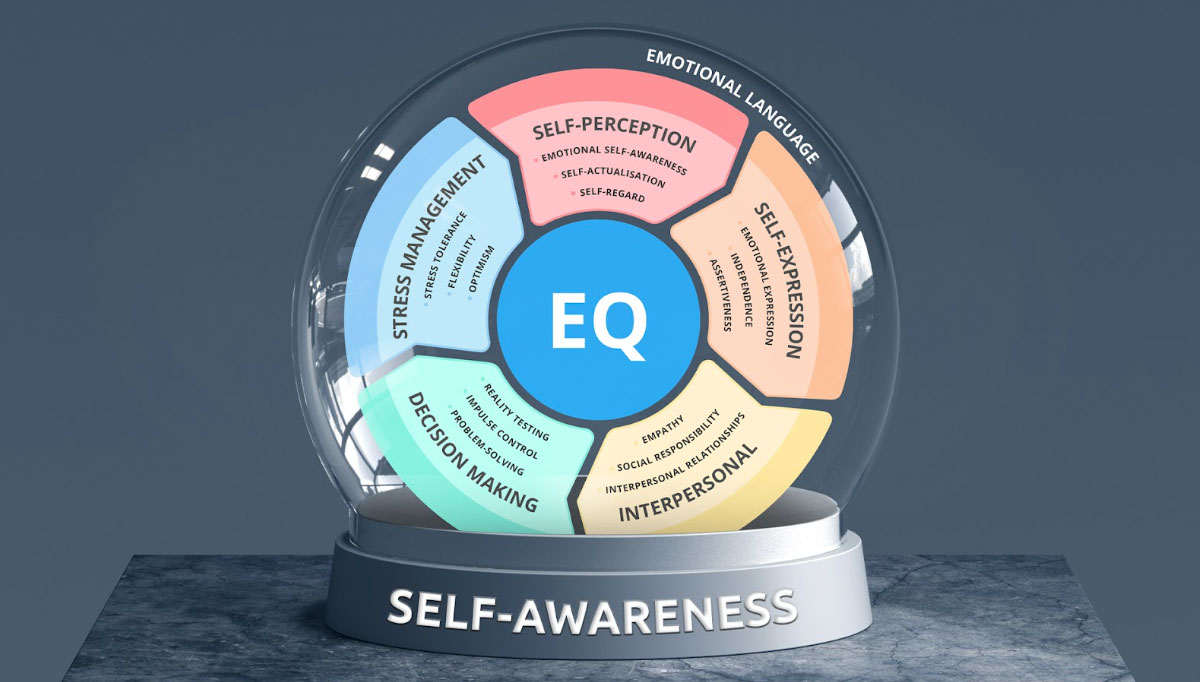
The core of Mygrows EQ model, draws primarily from the Bar-On EQ-i 2.0 model (the updated version of the original EQ-i above), often referred to as the 1-5-15 model. This framework offers a practical map for development:
- 1 thing being developed: Emotional Intelligence.
- 5 core competencies: Self-Perception, Self-Expression, Interpersonal Skills, Decision Making, and Stress Management.
- 15 sub-factors: The specific skills that make up each core competency.
Along with Daniel Goleman’s ECI framework, we recognise Self-Awareness as a crucial stabiliser (the plinth of the snow globe) that provides stability for the entire set of competencies.
We also believe that developing a robust emotional language to assist in perceiving, facilitating and understanding emotion is essential for accurately interpreting the internal data required to navigate the complexities of EQ.
Within this framework, emotional language acts like the liquid in a snow globe, saturating and informing every other skill. By synthesising the distinct strengths of the EQ-i 2.0, the ECI, and the MSCEIT, we have developed the Mygrow Snow Globe model, providing a comprehensive map for a person’s developmental journey.
Why EQ Matters
The rise in prominence of EQ and Emotional Intelligence is not coincidental. Empirical researchers investigating human success and flourishing clearly discovered and demonstrated that EI is a dominant and causal factor for personal and organisational success (Goleman, 1995, 1998; Hosie et al., 2012).
The unique contribution of EI is that it allows us to see thought and emotion as adaptively and intelligently intertwined (Mayer & Ciarrochi, 2006). When you understand your emotional triggers and your habitual responses, you can begin to make better decisions, not just ones driven by impulse, but ones informed by a deep understanding of your own internal landscape.
Rewiring Your Emotional Centres
The most exciting part of this research is that EQ skills are not fixed traits. Unlike cognitive intelligence, which is fairly static beyond the age of 25, emotional intelligence consists of competencies that can be developed. Through neuroplasticity (the ability for the brain to morph and change based on neurological impulses), you can engage in techniques to rewire the emotional centres of your brain. Just as you would go to the gym to strengthen muscles, you can treat EQ development as a daily habit of exercise and actually see results.
These techniques work from the inside out. For some individuals, there may be significant work required in their psychological core; for others, it might be about realigning a few specific habits. Regardless of where you start, the focus remains the same: strengthening the core so that you can flourish in all areas of life.
Key Takeaways for Your Journey
- EQ is a set of skills that can be developed: You can develop it through consistent practice and technique implementation.
- Self-Awareness is a foundation: self-awareness alone is not EQ, but it is a key stabiliser for all EQ competencies.
- Distinguish between models. Understand that different models (like the EQ-i 2.0 or MSCEIT) offer different perspectives, but they all share the goal of helping you manage yourself and others better.
- Practice is essential. Knowledge alone is insufficient; you must implement techniques repeatedly to see change.
As you look to move forward with some new insights on EQ, remember that this is a journey. It is not about reaching a destination where you are “fixed,” but rather about continuous growth along a wide array of competencies. There is no doubt that if you commit to developing your emotional intelligence, you are investing in the most important asset you have: yourself.
Start Using Mygrow To Develop Your EQ!
To develop your and your organisation’s emotional development, Mygrow’s micro-learning approach in the form of a daily droplet helps people to learn while putting into practice techniques that make a tangible change in their behavior and ability to grow into a better version of themselves, with EQ.
Individuals can sign up by downloading the Mygrow App on Google Play or the App Store. Organisations can reach out to our team to explore options for developing EQ at scale in the workplace.
Further Reading
- Emotional Intelligence: Salovey & Mayer, 1990
- Human Abilities: Emotional Intelligence: Mayer, Roberts & Barsade, 2008
- EQ-i: Bar-On Emotional Quotient Inventory: Bar-On, 1997
- Working with Emotional Intelligence: Daniel Goleman, 1998
- A Review and Critique of Emotional Intelligence Measures: Conte, 2005
- Long-Term Impact of Emotional, Social and Cognitive Intelligence Competencies on Career and Life Success: Amdurer et al., 2014